CSR and Financing software
Why digital native leasing management systems can easily handle ESG / CSR requirements.
Corporate social and environmental responsibility have become an essential part of corporate management, with increasing pressure on banks. Ultimately, the end customers are the ones who decide what they want to acquire through credit or lease, leaving little room for incentive for more environmentally responsible goods. At first glance, apart from the development of partnerships with relevant suppliers and possibly a more incentive-based pricing system that is not necessarily compatible with profitability objectives, such incentives are limited. However, we shall not neglect this point because of the impacts of regulatory declarations and capital requirements that will appear at the end of 2023.
The eco-responsible logic creates a new logic of asset management
Nevertheless, the eco-responsible logic creates a new asset management logic. Before, a forklift battery (the vehicles used to transport pallets) had a lifespan of 2 years and could be considered as consumables in the same way as renewable tires. As their lifespan is now 7 years (and will continue to increase), they still have a significant market value at the end of the lease. It is therefore mandatory to manage :
- a reuse/reselling process dedicated to batteries,
- a second net asset value in the lease contract,
- and above all to predict that it will probably change over time.
This point is even more critical as the battery becomes a major component of the value of the asset: the vehicle is almost an accessory element of valuation.
The leasing company must develop the management of the maintenance of all the components associated with the asset
Therefore, the leasing company must develop the management of the maintenance of all the components associated with the asset, monitor compliance with the maintenance plan and of course develop partnerships with all the companies involved in this maintenance.
Eco-responsibility implies to set re-renting or recycling processes
In addition, eco-responsibility implies to set processes for re-renting or recycling. Yet, most of the current financing offers focus on financing new equipment and only consider the end of life of equipment in professional leasing through an auction based reselling.
The development of "Pay-Per-Use” leasing is a means of multiplying users for a more intensive use of goods
The development of "Pay-Per-Use” leasing is a means of multiplying users for a more intensive use of goods. Depreciation is therefore no longer over an average lifespan, but more on usage (kilometers, number of pieces built with the machine, …). The asset becomes useless sooner and thus the duration of ownership is no more a relevant parameter for the depreciation.
This is one of the aspects potentially creating the most changes in financing offers. As a consequence, less goods are produced, but they are replaced more frequently, ultimately resulting in significant CO2 gains on manufacturing (fewer goods, all more recent thus more efficient).
One can imagine the impacts of IT systems on pricing, depreciation "per type of asset", and the complexity of management of this type of rental.
Carbon footprint regulatory reporting
Finally, CO2 reporting is not yet an obligation, but increasingly becomes a social requirement, if not soon a regulatory requirement. Please note the standardization efforts in this reporting area, for example via the "Greenhouse gas protocol".
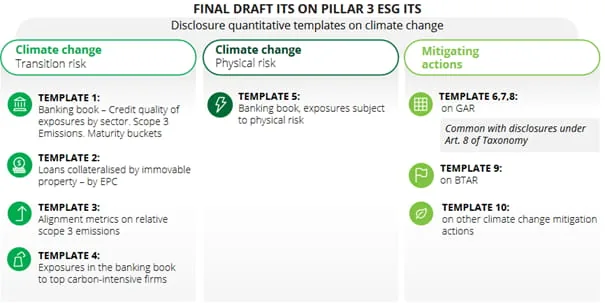
It should also be added for the record that the European Commission is producing a report for which various working documents have already been published. In addition, the European Banking Authority (EBA) published on January 24th, 2022 the final draft implementing technical standards (ITS) on Pillar 3 information relating to environmental, social and governance (ESG) risks. The technical architecture has to be designed as soon as possible, which is not an easy task when its content is unknown or not well known.
CO2 and other waste management savings is a complex computation process. This naturally requires a major measurement setup upstream, and therefore the construction of an ecological value matrix. Manual computation is of course not acceptable for large financing institutions. It is therefore imperative to find an automatic and if possible real time solution, triggering the equivalent of a non-monetary off-balance sheet accounting entry, in "CO2" or equivalent units. A functional analysis must be done on this type of entries. In the end, it involves delicate accounting processes rarely possible with legacy systems.
Current leasing software must evolve significantly to deal with these new logics
Current leasing software applications must therefore evolve significantly to deal with these new logics:
- It should be possible for pricing to evolve based on several underlying assets whose future value may change regularly,
- Maintenance partnerships should be developed beyond distribution partnerships, with dedicated processes for managing and monitoring service quality,
- End-of-life asset management process should be configurable with the ability to record the asset as a set of components
- With a relocation process to reuse batteries that have not completed their life cycles;
- With a process to systematically recover end-of-life assets and manage recycling;
- Accounting processes should be reviewed to generate non-financial entries allowing the recording of eco-responsible gains or consumption
Solutions that are not supported by configurable low-code workflows and do not offer a flexible and scalable pricing engine will not be able to adapt to this new context. The challenge for leasing companies will be to find a relevant solution that is not too complicated to deploy.
For further information contact-us.
January 26, 2023