How to build a loan or lease platform in the digital era?
What features do you need to build a Lending or Leasing IT system for the next 20 years
Last week, I had a conversation with the CEO of a major European leasing institution, and she told me this: "There used to be a time where IT and digital matters were barely discussed at CoMex level. Today, it has become a subject of strategic importance, and 2023 banking industry leaders need to understand IS architecture and the underlying mechanisms."
Therefore, I believe anyone concerned about the current state of their information system should take the time to read this article. I promise it has the right balance of business jargon and geek-techy stuff.
To begin with, let's say I am a financial institution and my current lending or leasing platform is “unsatisfactory”. I want to (re)build it based on 2023, state-of-the-art foundations. This is a huge project, so I want it to stay relevant for at least 20 years.
First, I need to make a list of all the topics that matter and the features I need.**
Some features will be generic to any business application:
- Able to cover all business requirements (end to end, front to back, omni channel, etc.)
- Future proof
- As independent as possible from the software vendor
- Accelerated time-to-market
- Easy to maintain and enhance
- Able to work in any country
- Easy to integrate with my existing information system
- Based on a sophisticated user management system
- Based on workflows
- Maximum automation of tasks
- Able of processing gigantic volumes at a rapid pace
- Able of efficiently extracting all data for reporting purposes
- Built-in dashboarding capabilities
- State-of-the-art, future-proof technical stack
- No over-engineering
- Infinite scalability
- 24x7 availability
- Fast response time
Other characteristics will be specific to the loan and lease industry:
- Supported by a team of business analysts and engineers who are experts in the field
- Powerful financial calculation engine
- Good financial product model
- Minimum "Time to Yes"
- Easy to integrate with the financial ecosystem
- Able to support and adapt to regulatory constraints
Now, I know that is a lot of requirements, some of them being quite technical on top of that. But as a 2023 leader I am not afraid of technology, so let's dig a bit more into each of them.
Being able to cover all business requirements
In order to build a new system, the loopholes left by the previous ones have to be closed. Of course, a lot of loan and lease softwares already exist, with big names as references, but they are pre-digital. I need a modern platform that is “digitally native” and doesn't merely add digital capabilities on top of obsolete foundations. Everything must be doable “online”, from any device, at high speed.
On top of that, I need to be able to “extend” and customize a standard platform to match my own requirements in a matter of days, not months. Older platforms tend to be monolithic, with limited configuration capabilities and monstrous lines of code that only the bravest dare to mess with. On the contrary, I need to break down the Chinese wall between business analysts and hardcore developers, so that even non-experts can directly handle the (re)configuration of the platform. To achieve this, I need the platform to be based on “low code” i.e., require little to no coding. The future of agility lies in “double-pizza teams” where less than a dozen of engineers can handle the whole platform.Being future proof
We are building a system for the next 20 years or more, who knows what will come tomorrow? I can't afford for the way I do business today to be based on hardcode, I need adaptability at all times and in short timeframes. Again, smart extensions and low code are key to allow my platform to be adaptable to inevitable future changes.Keeping me as independent as possible from the software vendor
In a perfect world I would do everything with my in-house IT resources, but I do not have enough time or money. Even if the project succeeds, I may have problems maintaining the platform in the future. I can go faster if I rely on a third party, but I will depend on him. I need to strike a balance, with a software editor that provides me with a turnkey, operation-ready system, but also the configuration capabilities needed to adapt it to the specific requirements that make my business unique.
To obtain resources from integrators at competitive prices, I also need to use standard technologies as much as possible and shy away from proprietary languages. This way, I will have a choice over the integrator I choose, and this concurrence will help me keep the price low, hence reducing my TCO.Having an accelerated time-to-market
The competition is fierce. In this race for the stars – that is for digitally-native services and seamless user experiences – I need to be the first to plant a flag on the ground. For instance, the MVP should go into production in 6 months. What's more, the business is constantly evolving, and requirements are changing faster than that. Therefore, not only does my new system need to be up and running as quickly as possible, I also need to be able to improve it on the fly over time, for example every two weeks.Being easy to maintain and enhance in a short timeframe
I don't have to be afraid of continuous upgrade. In the past, companies would spend millions of dollars and go through expensive and time-consuming upgrade projects to migrate to the newer version of whatever system they were using. Instead, software updates must be pushed automatically and not actually visible to the end-user. Does Amazon tell you when they upgrade their platform in the background? Exactly. Just because a feature is built, tested and integrated doesn't mean that customers necessarily need to be notified.
Plus, waiting to bundle up a bunch of features changes in one big upgrade makes it much harder to figure out which change caused the unexpected side effects, such as bugs and regressions.
Again, to support automated continuous upgrades, less lines of codes are key. Using drag-and-drop features to move around and replicate lines of code will allow me to shorten the software development lifecycle. I will then be able to build the perfect CI/CD (Continuous Integration and Continuous Delivery) pipeline so that my teams can deliver code changes more frequently and more reliably thanks to task automation and replication. Being able to build and deploy new software features in 2 minutes means you can do it 100 times a day.
Also, the code must be normalized, every feature has to be developed in a standard way, and every API must follow the same rules so that configurators and integrators can easily find their way around the inevitably large set of APIs.
Finally, these updates need to rely on TDD – Test Driven Development – to make sure they deliver a smooth functioning product without any bugs or regressions. Only frequent and automated testing can guaranty stability across time, in real time. There must be code reviews, but they don't need to be blocking i.e., to prevent the code from merging with the main code line until it has been reviewed. This is counterproductive because it creates major bottlenecks, increases lead time and generally lead to inefficiency when configurators and developers must deliver quickly to avoid conflicts with colleagues.Being able to work in any country
Loan and lease used to be granted on country-by-country basis. That's no longer the case in 2023. I need to think on a European, or even global, level. I need a model that allows me to roll out a new country in a matter of weeks, while adapting to local constraints. Or, if I want a single implementation, I need a one-stop-shop model where several countries are deployed simultaneously and are kept independent by Chinese walls to ensure that each of them respects their specific constraints.Being easy to integrate with my existing information system
Of course I have a preexisting IT system that hosts legacy applications with business-critical data and services (SSO Single Sign-On, security, monitoring, reporting, accounting, compliance and conformity, CSR, etc.) and on-premises technologies (data warehouses, data lakes and workstation infrastructures).
I need to integrate this legacy system with the new one, and that means linking up different data sources and autonomous components. I could write ad-hoc interfaces to access the data, but this would be slow and costly. Wouldn't it be better if my platform could rely 100% on the plug-in capabilities of APIs (Application Programming Interfaces), meaning I won't have to reinvent the wheel each time I make my internal applications and services accessible to my customers, business partners, suppliers, and other third parties?
Of course, for particular requirements that call for specific interfaces, I need to be able to create ad hoc APIs myself, without being dependent on the software publisher who will probably charge me a lot of money. The best way to achieve this is through configuration, because it means I don't have to wait for the full R&D cycle to be completed before I can use the new APIs.Being based on a sophisticated user management system
In an open digital world, many different user profiles – from customer and partners to back-office staff and administrators – will be using my system, all with different rights and duties. To make sure everything runs smoothly, I need “user segmentation”, i.e. to define hierarchies and “right of actions” between users. Only the right users should be able to accept a contract or to write off some unpaid amount. A sales representative should see only the contracts he initiates, just like an agency manager should see only the contracts of the sales representative he manages.Using workflows to model the lifecycle of the business entities
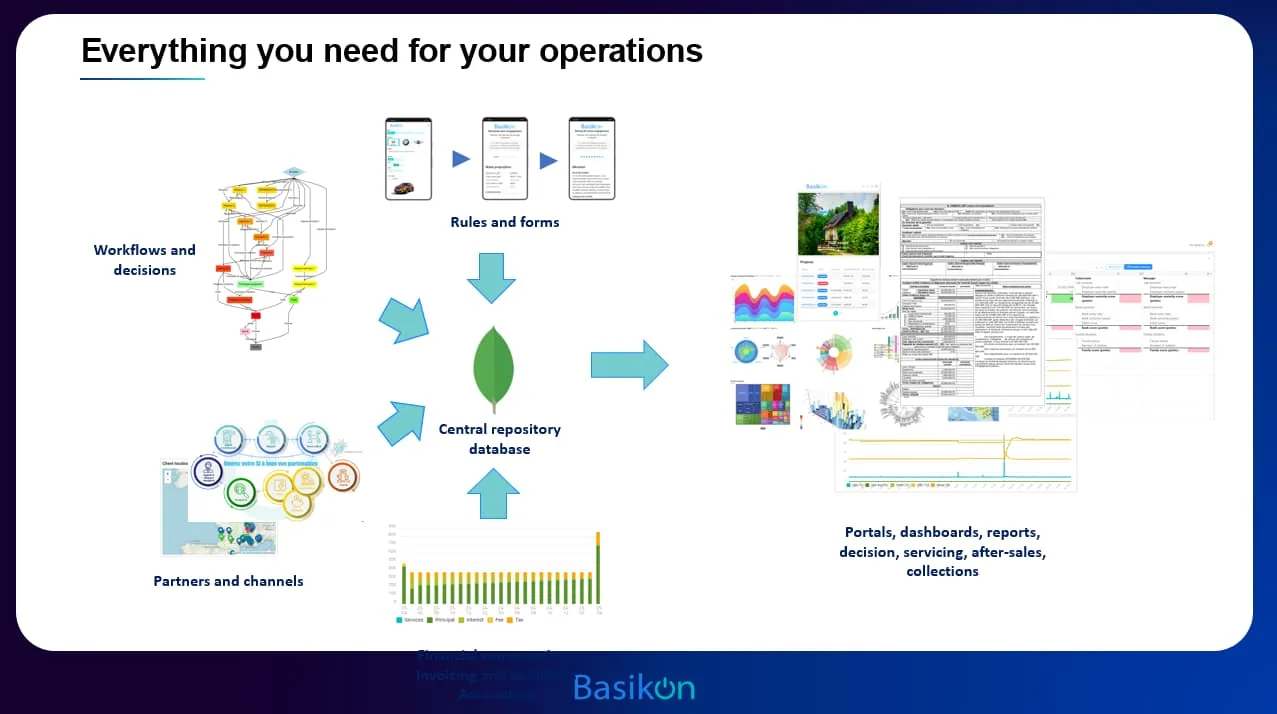
I have many interrelated entities in my IS, with different statuses. Some of them are at the beginning of their journey and need validation by multiple third parties before reaching “live” status. Others are at the end of their lifecycle and need to be retired for GDPR-related reasons. Each status transition will require an action on the part of a user or a call to an internal or external API, all protected by access control authorizations based on the user's profile. There is a lot of complexity here, so I need a graphical representation of those lifecycles. I could document them myself, but it would take less time and be less error-prone if my platform could do it for me.Enabling maximum automatization of tasks
Thousands of people will be using the platform, and I don't want them exchanging emails. I want every user, whether it's a customer, a sales rep, an underwriter, a fulfilment agent or a debt collector, to be able to use the self-service platform as much as possible. I also have call centres in action helping the customer and they need tasks pushed to their desktop with some measurement of how long it takes them to process the task.Being capable of processing gigantic volumes at a rapid pace
I will handle hundreds of thousands of contracts with many payables and receivables. Every night I will need to generate countless payments, invoices and PDFs, all in the shortest possible time. Therefore, I need a system with a parallel batch architecture i.e., capable of processing multiple jobs simultaneously as a batch. For tasks that involve the whole database, I need an ETL (Extract, Transform, Load) pipeline that can collect millions of data sets from multiple sources, process and transform them in a matter of minutes.Having built-in dashboarding capabilities
In order to pilot I need a cockpit. All users require insights and 360° views of their current tasks, activities and interactions. Those insights must be provided in the form of charts showing a graphical synthetic overview of the data. As each diagram or graph is different, I need to be able to create them on demand.Providing a state-of-the-art, future-proof technical stack
What is the best programming language today? JavaScript. It's a multifunctional language that can be used for various purposes, such as web development, mobile development, desktop applications and so on. It's easy to get started with therefore all young engineers learn JavaScript at school. Plus, REST API technology is based on JSON, which is JavaScript. Then there is the choice of the database. SQL databases are a powerful tool. They enable to store data in rows and tables that are linked in various ways. They offer fast storage, can handle great amounts of data and complex queries. However, they can be a headache to maintain because they rely on strictly predefined schema, that require organizing and structuring data before starting with the SQL database. On the other hand, NoSQL databases systems allow you to work with different data structures within a database. Because they are more dynamic, there's less need to pre-plan and pre-organize data, and it's easier to make modifications.
By using a combination of pure JavaScript and NoSQL one can build a direct access to items such as contracts or invoices in a few lines of codes. Less code means greater productivity, less maintenance, fewer bugs and blazing processing speed.
What is the best NoSQL database around: MongoDB. And they provide DBaaS (Database-as-a-Service), too, with infinite scalability at a fair price. So, all in all, there is no doubt Basikon did the right choice when it picked the MERN (MongoDB, Express, React, Node) stack 5 years ago. The MERN architecture allows to easily construct a three-tier architecture (front-end, back-end and database) entirely using JavaScript and JSON. This choice has made it possible for Basikon to build up complex interfaces with out-of-the-box functionalities using simple components....while keeping it as simple as possible (no over-engineering)
I want to limit the number of technologies I use in my platform. This is key for good performance and maintainability. So, every time someone wants to introduce something new, we will ask ourselves “do we really need it, does it introduce dependency on a third party, does it increase the complexity of monitoring, does it add new skillsets for maintenance, does it make it more complex to understand exactly where a problem occurs in production, does it increase the number of lines of code”. By following this principle, we can make sure we keep a high level of maintainability and robustness.Being infinitely scalable
For infinite scalability, I need “elasticity”. I need a system where I can simply add servers to support more volumes. I need to get rid of all bottlenecks, so I need a "stateless" infrastructure, where any request from any user can be executed simultaneously on any server that is currently switched on, whether it was started the day before or half a second ago.Being available 24x7
In 2023, people do not want to be obliged to make loans or leases only during opening hours. They want to be able to do it also early in the morning and late at night, at any time in fact. That's why I need my platform to be up and running for them at all times. As a consequence, I want an infrastructure with no SPOF i.e., no “Single Point Of Failure”, where I can pull the plug on any server, application, database, DNS or reverse proxy, at any time without causing the whole system to fail.
This robustness can also be obtained with “stateless” infrastructures, where any query can be executed on any server and take multiple routes between any two destinations on the network. And if some server goes down (they always do, eventually), the same query can “route around” the failure so that the user doesn't even know it happened.Having a fast response time
Fast response times are also due to simplicity: straight-through processing, simple technical stacks, stateless server architectures, NoSQL databases. I mean, why do we still have mainframes around although there are often seen as dinosaurs ? Well, if they're dinosaurs, they're T-Rexes because they are capable of crunching millions of lines in the blink of an eye. We need the same kind of speed, reproduced on a modern stack.
Now that we have the fundamentals of our software platform, let's dig into the specifics of loans and leases.
Being supported by a team of engineers who are experts in the field
In 2023, it is essential to have employees who know both the financial world and the digital world. Companies that can't find these resources end up with people who know business and people who know technology. It then takes countless meetings and debates to align them.
The team also needs to be international. Having one expert per country means even more meetings. At Basikon, we have assembled a team of over 40 people, each with decades of experience in the loan and lease industry AND the digital world. And because we like to be close to our customers, we've created local teams in your time zone, able to work in French, English, Spanish, German, Dutch, Arabic and so on. What's more, we've built up a network of integrators who know how to deploy Basikon, so we can scale up very easily.Being a powerful financial calculation engine
Calculating loans and leases is not rocket science. The difficulty lies in the many subtleties that have been added over the years, as many different uses have emerged. Let us give you a few examples:
- Are payments daily? Weekly? Monthly? Quarterly? Semesterly? Yearly?
- Does the customer pay interest every month or at the end of the loan?
- Does he pay interest on the same day as the start date or is the date arbitrary? Does the lessee get to choose the date?
- Is it constant instalments? Linear? Seasonal?
- Do we consider a year to be made up of 12 months of 30 days ("30-360" or "LOAN", our default), or 365 days with the actual number of days in each month ("ACTUAL-365")?
- Is there a grace period at the beginning?
- Is there an initial payment (usually high)? Is it calculated as a number of instalments paid in advance, or entered as a number?
- Are there any assets? Is there a residual value at the end? Is there a balloon at the end?
- Does the bank or the customer own the property for the duration of the lease? Will the customer own the property at the end of the contract or is in fact pure rental?
- Is there any insurance, maintenance services or fees? Are they paid in advance or monthly? Are they calculated on the basis of the amount of the instalment, the amount financed or any other value?
- If the payment falls on a Sunday or public holiday, is it carried over to the next day? Does this affect the calculation of interest?
- If I use the long channel, there will be an intermediary or reseller (in Basikon we say "partner") that will demand special rules after negotiation. Can we change those rules in a controlled way?
- What is the rounding model?
- ... and many more
How do we manage all this? At the start of many projects, our client tells us "I'm using the standard approach" and then we realise that nobody knows exactly what that means! Our best practice is to start by modelling the different cases and carrying out the complete calculation as accurately as possible. Once we have the definitive vision on our spreadsheet, we configure it in the system using the same functions and algorithms as Excel.
Being a good financial product model
One challenge the customer will usually face when entering into a lending or leasing contracts on a digital platform is the sheer complexity of the screen's configuration. Because the software platform must support all business cases, the user interface is usually very busy and difficult to navigate. At Basikon, we believe that this one-size-fits-all approach doesn't work for everyone. We have solved this issue by using low code and customer segmentation to design experiences tailored to the customer, based on their own vocabulary and business rules.Allowing minimum "Time to Yes"
Today, competition in the financial ecosystem is fierce as banks battle to (re)finance the best offers. The winners will be those that provide the best (multiple) scenario in a matter of seconds, allowing users to choose the one that best suits their own needs. The question now is how quickly customers can get the bank's approval? The bank's platform needs to be light, efficient and capable of calculating as quickly as possible. With Basikon, you can calculate hundreds of thousands of scenarios in half a second and get a score very quickly.Being easy to integrate with the financial ecosystem
We leave in a world of APIs, where various set of codes and protocols allow different applications and software components to communicate with each other. What is more, those same APIs enable what we call “open banking”. By promoting networking between third-party providers (TPP third-party providers) and financial institutions, they allow the new players, such as FinTechs and online payment portals, to access consumer banking information in a safe and efficient manner. To achieve a robust and deep integration with my existing information system and the wider financial ecosystem, I need a system like Basikon which is 100% API-based. I also need configuration capabilities to be able to create ad hoc APIs in a matter of hours and integrate with my partner's information system on the fly, as and when needed.Being able to support and adapt to regulatory constraints
Regulators are very creative, causing my IT department to constantly adapt to morphing regulatory requirements even though it adds little value to my business. I need them to be able to make these changes quickly and at a reasonable cost. So (again) I need a highly adaptive system, not one of those monoliths that can't be changed without waiting months and paying a lot of money.
Now you know all about the technical intricacies of an efficient, agile and competitive lending and leasing platform. What you've just read is also the thought process we went through when we created Basikon 5 years ago. We haven't regretted any of our choices, and since then we've signed up a number of major banks across Europe and Africa. We would never have got this far if we had not started from scratch, if instead we had tried to migrate technologically outdated systems and slow pre-digital practices into the digital age. It's been a long journey, and one that has required considerable investment from the whole team, but we are now confident convinced today that we have made the right choice.
To find out how our approach can be adapted to the specific requirements that make your business unique, book a meeting with Basikon here!
November 17, 2023